After the Gale
North Pacific · 40.9° N, 149.5° W
The gale blew itself out in the night, as Priya said it would. By six this morning the sea was still heaving, but lazily, in long grey rolls, and the wind had dropped to something you could stand up in.
I stood up in it. I was very proud.
Deck rounds
After any heavy weather, every lashing on the ship is checked. Every single one. On a ship carrying nearly twenty four thousand containers, a great many of them on deck, this is not a small undertaking, and it falls to Tiny and his deck crew.
I had asked to come. Tiny had said I could watch if I could stand. At seven he found me at breakfast, looked me up and down, and handed me a hard hat, a high visibility vest, a pair of gloves, and a lifejacket, and said, "You stand where I tell you. You touch what I tell you. You do not touch anything I do not tell you. If I say stop, you stop."
I agreed to all of it. He made me repeat it back.
Lashing, explained badly
Here is what I learned, which I am going to explain imperfectly, and for which I apologise in advance to every bosun reading this.
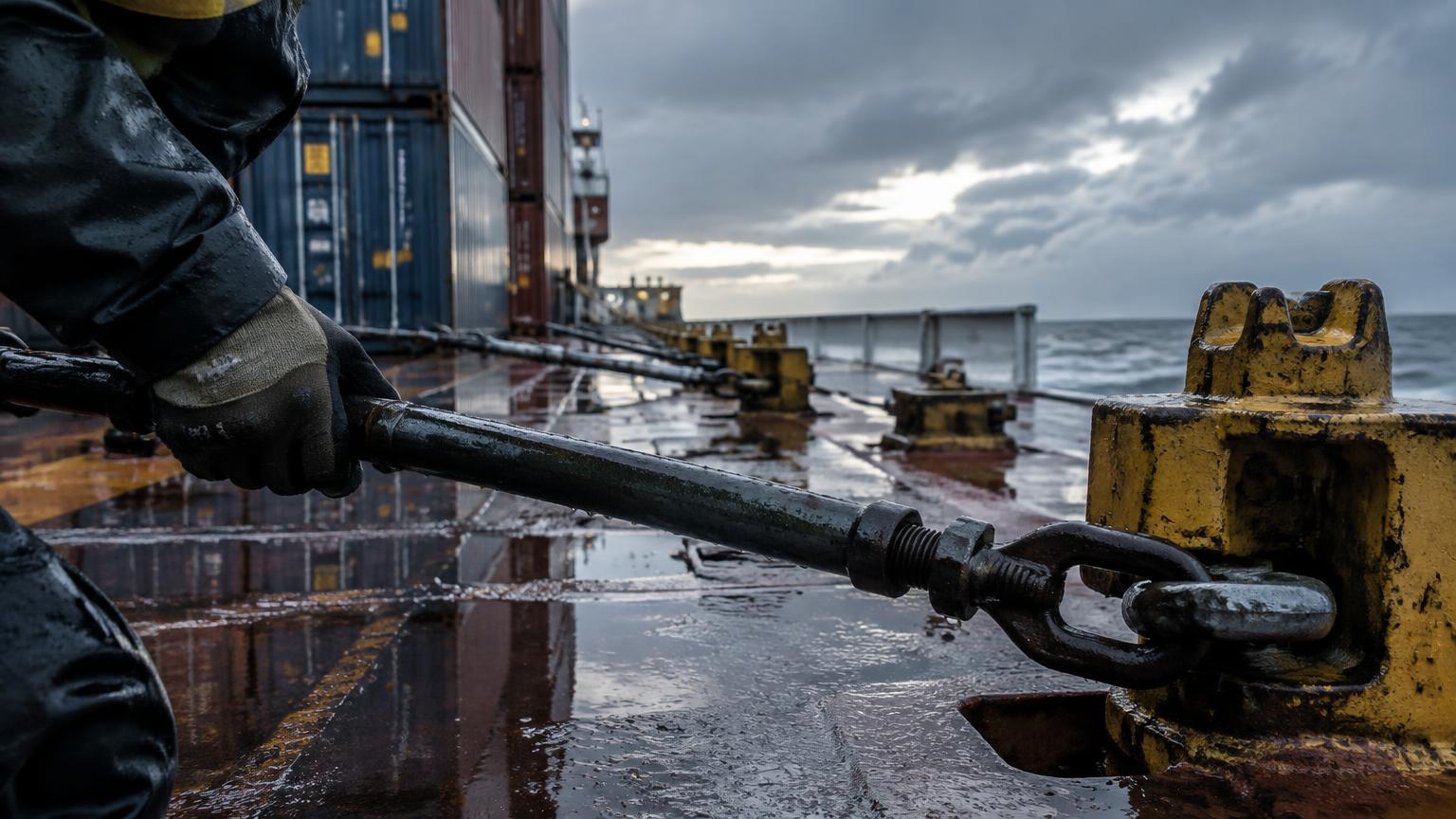
Containers on deck are locked to each other at the corners by twistlocks, which are clever little devices that turn and lock when one box is placed on top of another. The bottom layers are then tied down to the ship with long steel lashing rods, which run diagonally from the corners of the boxes to points on the hatch covers. At the bottom of each rod is a turnbuckle, which can be tightened or loosened with a long bar.
In bad weather, everything moves a tiny amount. Things work loose. A turnbuckle that was tight yesterday might be a turn or two slack today. A twistlock might not be fully seated. So after a gale, Tiny's crew walk the entire length of the ship, bay by bay, row by row, checking everything by eye and by hand, and tightening what needs tightening.
It is slow, wet, heavy, careful work. It took the whole morning and most of the afternoon.
My contribution
My contribution was mainly to stand in the right place and hand things to people. I am a good handler of things. I learned this, as Tiny did, in the footwell of a car, holding a torch. It is the hardest job in engineering, and nobody thanks you for it.
But around mid morning, on a lashing bay near the bridge, Tiny stopped beside a turnbuckle and said, "This one. You."
He showed me how to fit the bar, where to put my feet, how to keep my body out of the line of the rod in case anything let go. Then he stood beside me with his hand very close to mine, and I heaved.
It was much harder than I expected. I am a man who once rebuilt an engine with a borrowed crane and a bad back, and that turnbuckle made me feel like a schoolboy. On the third heave it took up the slack, and I felt it go tight through the bar and into my shoulders, and Tiny said, "Good," and moved on.
He did not make a fuss. That was the best part.
A car analogy
Over a mug of tea on the lee side of a hatch cover, Tiny said that lashing a ship is like setting up a car's suspension. You want everything tight enough to hold, but you want it to work as a system. Too loose and things move and break. Too tight and the load goes somewhere it should not. The trick is balance.
I said that was the best explanation of suspension I had ever heard. He said that was because I had been listening to the wrong mechanics. I did not argue.
He also said, very quietly, that the floating container we passed off Rotterdam was almost certainly the result of somebody, somewhere, not doing this job properly. That is why they do every single one.
Afterwards
By the time we finished, the sky had cleared to a washed out blue, and the sea had settled to a gentle, glittering swell. My arms were shaking. My back was talking to me in a tone I recognised from the engine crane years. My gloves were black.
At dinner, the Captain stopped beside my chair on the way to his table. He looked at me for a moment. "Deck rounds," he said. "Good. Thank you." Three words, and then two more, which I have been told is practically a speech.
Elena gave me a second helping of goulash, which has returned from its rest. Container smelled my gloves and decided I had been somewhere interesting. She slept, tonight, curled against my aching shoulder, which was warm, and which I needed more than I would like to admit.